
I came across a teacher discussion asking why students don’t get in serious trouble anymore. Before getting into any of the explanations, I found myself stuck on a different question altogether. Why is “serious trouble” something we’re aiming for in the first place?
That framing assumes escalation is not only appropriate, but necessary. It assumes that punishment is the missing ingredient in education, and that if children were simply held accountable more forcefully, things would improve. It also assumes that when schools struggle, the most logical place to apply pressure is on the students themselves.
Those assumptions deserve more scrutiny.
Stop Attacking Children
As I read through these conversations, I don’t just see concern about behavior. I see contempt. Students are described as lazy, distracted, unmotivated, mouthy, or frustrating, often with a level of disdain that feels normalized rather than questioned. The tone suggests that kids themselves are the obstacle, so what follows is predictable.
Children are reduced to behaviors. They are discussed as problems to be managed instead of people to be understood. When that starts to feel uncomfortable, responsibility shifts to parents, as if parents have full control over their children’s thoughts, emotions, and actions. As if another human being’s internal world can be governed externally.
That isn’t how people work.
Adults can set boundaries, model expectations, apply consequences, and respond to behavior. Some consequences matter, and some fear is rational. Fear of real harm, real loss, or real accountability plays a role in keeping people safe. What does not work is manufacturing fear to enforce compliance and calling that control. That approach relies on coercion, not understanding, and it only functions as long as people are willing or able to submit to it.
Expecting parents to manage children through that kind of pressure is unrealistic, especially when much of what children are reacting to exists entirely outside the home. If improvement is truly the goal, the first thing that needs to stop is attacking children and parents for problems they did not create.
The Frustration Is Real
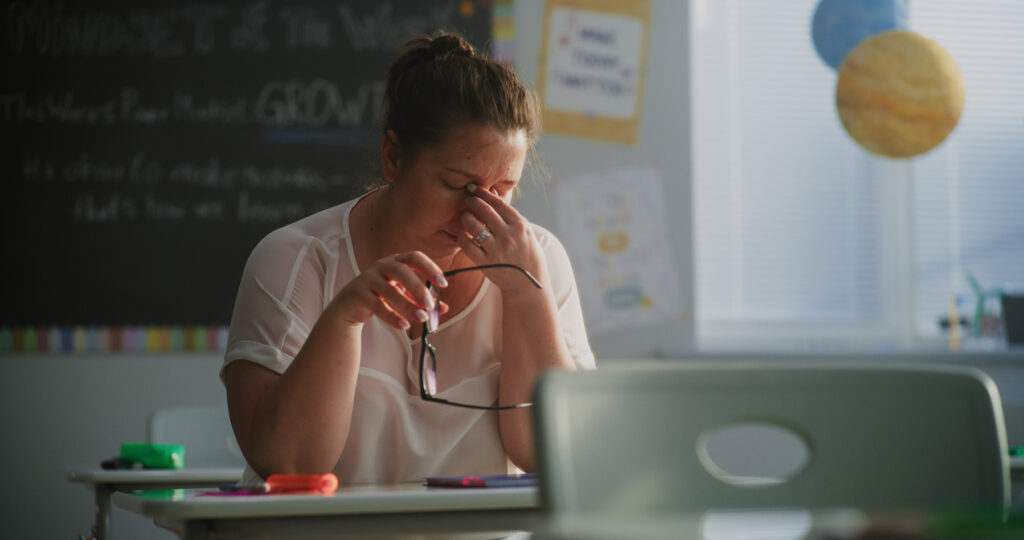
At the same time, the frustration teachers are expressing is real. Behaviors like foul language, speaking out of turn, verbal pushback, emotional outbursts, disengagement, withdrawal into devices, and resistance to rigid environments make classrooms harder to manage. Acknowledging that reality is not the same as endorsing punitive responses.
Those behaviors also communicate information.
They reflect what it feels like to exist inside these environments, and they reflect the position teachers are being placed in. When teachers describe students this way, what comes through most clearly is exhaustion. Many feel unsupported, exposed, and responsible for outcomes they do not have the tools or authority to meaningfully influence. Fear around lawsuits, pressure tied to federal guidance and funding, endless documentation requirements, administrative turnover, and inconsistent leadership all surface repeatedly.
If you’re listening enough to hear all of that, their frustration makes perfect sense.

Children and Parents Become the Targets
What does not make sense is where all of that frustration gets directed.
Children did not design this system. They did not create funding formulas, documentation requirements, staffing shortages, or administrative churn. They do not write federal guidance, and they do not set disciplinary policy. Parents do not either. None of the pressures teachers are describing originate with the people sitting in front of them each day.
And yet, those are the people absorbing the impact.
When systems are under strain, attention shifts away from structure and toward the people who appear most immediate and most manageable. Curiosity gives way to judgment. Behavior stops being something to interpret and becomes something to correct. Students are treated as adversaries instead of participants. Parents are framed as obstacles rather than partners.
This is not a failure of children or their families. It is a predictable outcome of systems that push pressure downward instead of addressing it at the source.
Control Became the Tool
Over time, schools have been taught that control is how expectations are met.
When classrooms are overcrowded and outcomes are narrowly defined, control becomes the mechanism holding everything together. Compliance keeps the system moving. Discipline enforces pacing. Punishment fills the gaps where flexibility and support are missing. When a teacher struggles, the response is rarely to change the environment. It is more classroom management training, more referrals, more documentation, and more emphasis on control.
This is evident in how student behavior is discussed. A student calls a teacher a bitch, and the conversation immediately centers on punishment and accountability. Accountability may be appropriate, but little attention is given to why the student holds that belief in the first place. Sometimes it reflects perceived unfairness or dismissal. Sometimes it comes from a pattern of interactions the student experiences as targeting. Sometimes it is a crude or ineffective attempt to express a real grievance.
None of that makes the language acceptable. All of it makes the situation worth understanding.
Most adults can recall moments where they spoke harshly under stress or frustration. Those moments may not have been productive or polite, but they were understandable in context.
The System Didn’t Change
While attention remains focused on behavior, the system itself remains largely unchanged.
Curriculum shifts. New initiatives appear. Communication with parents becomes more guarded. Expectations increase. Class sizes remain large. Staffing stays inadequate. Training rarely matches the complexity of student needs. Success continues to be defined narrowly through standardized testing and increasingly framed around college readiness, regardless of whether that trajectory fits most students.
Some administrators recognize that punitive control is ineffective and attempt to move away from it. When those shifts occur without meaningful structural support for teachers, a gap forms. Teachers are still expected to manage classrooms, meet benchmarks, and absorb conflict, while being told the old tools are no longer acceptable. With nothing substantial replacing them, the pressure does not disappear. It simply looks for somewhere to land.
What Control Actually Produces
I do not control my children. They are kind, thoughtful, and genuinely intelligent, and they are also deeply neurodivergent. I know what happens when control becomes the priority because I lived it. Stress escalated, relationships deteriorated, and one of my children followed my own adolescent trajectory closely enough that it led to suicidality and hospitalization. That outcome was not caused by insufficient consequences. It was caused by not being listened to inside systems that valued compliance over understanding.
This generation has a much lower tolerance for being controlled for the sake of compliance. That shows up in ways adults often find uncomfortable: swearing, pushback, emotional outbursts, refusal to soften reactions, and reliance on devices that offer distance from constant pressure. These responses are almost always framed as problems. They can also be read as information about which environments feel rigid, unfair, or unlivable to the people inside them.
Control can produce quiet classrooms and surface-level order, which may look like success in the short term. Over time, it also produces masking, avoidance, resentment, and disengagement.
The Real Question We Should Be Asking
So the real question isn’t why students don’t get in serious trouble anymore. It’s why trouble remains such a central tool, when curiosity, understanding, and real structural change are far more capable of supporting both teachers and students in meaningful, lasting ways.
Leave a Reply